
eIDAS Summit 26
The Wallet Is the Infrastructure


“Artifacts have politics.” — Langdon Winner
Note: This assessment is based on session recordings, open-source repositories, developer documentation, and sandbox materials published following the event. It is not based on in-room observation.
Introduction
For two decades, European digital identity meant a drawer full of incompatible national card systems, proprietary bank-issued logins acting as de facto government authenticators, and commercial platforms — Google, Apple — inserted as identity brokers at the authentication layer of public services. The legacy eIDAS 1.0 regime established notified eID schemes across member states but imposed no interoperability mandates and no open-source requirements. The result was a continent of sovereign identity visions that could not speak to each other, routed through commercial intermediaries that had no accountability to the citizens whose credentials they carried.
The eIDAS 2.0 framework, and the European Digital Identity Wallet architecture it mandates, is the legislative attempt to dismantle that model. The eIDAS Summit 2026 is where the ecosystem came to show whether dismantling is actually happening.
What Happened
The Bitkom eIDAS Summit 2026 took place on April 28–29, 2026, at the Berlin Congress Center, with a parallel international virtual programme. The event was organised by Bitkom e.V., Germany’s digital industry association, which operates under a joint Memorandum of Understanding with the Federal Ministry for Digital Transformation and Government Modernization (BMDS) alongside 119 participating organisations. Scale metrics are self-reported by the organiser. The Bitkom Events YouTube archive captured over 40 session recordings covering both the on-site national programme and the virtual international track — more than double the 35 recordings from the 2025 edition.
Session recordings are supported by version-pinned architecture concepts, API integration guides, and open-source repositories hosted on the European Commission’s GitHub organisation and the German government’s openCode GitLab instance. The post-event window of six weeks at time of assessment ensures all published materials are stable. The harvest is Rich.
The Analysis
Guided Insights
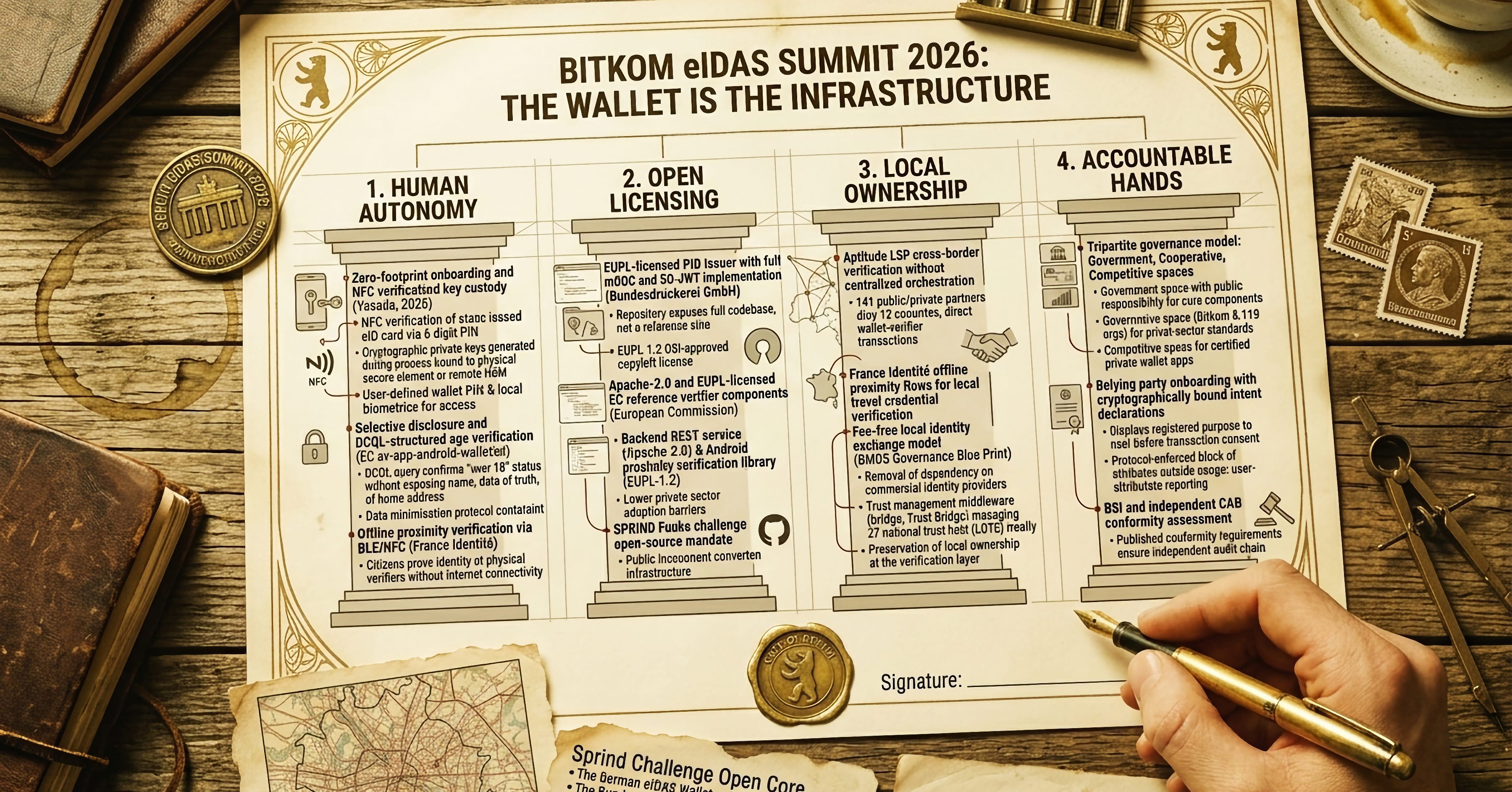
The hola framework evaluates contributions against four principles:
Human Autonomy – can users inspect, control, and operate the systems they depend on?
Open Licensing – are the legal and technical conditions of sharing structured to prevent proprietary lock-in?
Local Ownership – can infrastructure operate under local jurisdiction without centralized intermediaries?
Accountable Hands – are the builders and governors identifiable, reachable, and answerable?.
What follows assesses the eIDAS Summit 2026 against each.
✊ Human Autonomy
Five contributions provide evidence that the EUDI Wallet architecture is being built, at its foundations, around user control over credential disclosure — hardware-bound keys, selective presentation, and commercial platform decoupling.
Zero-footprint onboarding and hardware-bound key custody Kristina Yasuda’s presentation of the German National EUDI Wallet demonstrated a smartphone application that a user can download and activate without a Google or Apple account, without supplying an email address or phone number [1]. The onboarding flow begins with NFC verification of a state-issued eID card secured by a 6-digit PIN. Cryptographic private keys generated during this process are bound to the device’s physical secure element or a remote Hardware Security Module, accessed via local biometrics or a user-defined wallet PIN. An offline deactivation code — stored externally, outside the application — gives users an independent mechanism to disable their credentials following device loss [1]. The architecture decouples the identity layer from commercial platform infrastructure at every point where that infrastructure would otherwise insert itself. [Operational:2026]
Selective disclosure and DCQL-structured age verification The European Commission’s reference age verification application (av-app-android-wallet-ui) implements cryptographically signed attribute presentation in which users can confirm “over 16” or “over 18” status for age-restricted online purchases without disclosing name, date of birth, or home address [2]. The underlying OpenID4VP request uses a Digital Credential Query Language (DCQL) structure that requests only the boolean age-verification attribute. The relying party receives a verifiable assertion; it receives nothing else. This is data minimisation as a protocol constraint, not a privacy policy promise. [Operational:2026]
Offline proximity verification via BLE and NFC The France Identité wallet implementation operationalises same-device and cross-device presentation flows using OpenID4VP over localised Bluetooth Low Energy and Near Field Communication interfaces [3]. Citizens can prove identity in offline physical environments — airport border control, bank branch, pharmacy — without active internet connectivity and without routing the transaction through any cloud intermediary. The credential exchange occurs directly between the user’s device and the local verifier. [Operational:2026]
COSE split-signing with hardware-bound holder keys (Experimental) Under development in IETF internet-draft draft-lundberg-cose-two-party-signing-algs-04, this approach divides signing responsibility between a secure hardware token (a WebAuthn-enabled YubiKey acting as signer) and the wallet software (acting as digester) [4]. The architecture would allow holder keys to be generated freshly for each presentation — single-use, hardware-bound, unlinkable — preventing correlation across relying parties even when the same credential is presented repeatedly. Barriers: hardware vendors have produced only limited-availability prototypes; browser-level support requires active origin trial participation; IANA registration of split-signing algorithms is pending. Watch for: official COSE registry registration and stable IdentityCredential API browser support outside origin trials. [Experimental:2026]
Continuous session assurance and deepfake-resistant biometrics (Experimental) Industry observers are tracking pilot programmes exploring multi-modal biometric evaluation systems that combine face, motion, voice, and behavioural signals to perform continuous liveness detection throughout an active session, rather than relying on a static one-time login check [5]. The approach is proposed as a response to synthetic deepfake attacks on remote onboarding flows. Barriers: high computational overhead on standard mobile hardware; potential user experience friction; severe GDPR concerns regarding continuous collection and analysis of behavioural biometric telemetry. Watch for: ENISA publication of standardised, privacy-preserving biometric guidelines; CAB certification of multi-modal liveness detection modules. [Experimental:2026]
🖐️ Open Licensing
Five contributions support the finding that the EUDI contribution landscape is operating under principled open-source licensing — with one significant counter-example that sharpens rather than undermines it.
EUPL-licensed PID Issuer with full mDOC and SD-JWT implementation Bundesdruckerei GmbH published the complete Java and Kotlin codebase for its Personal Identification Data Issuer (pid-issuer) under the European Union Public Licence version 1.2 on GitHub [6]. The repository exposes the full implementation of mDOC and SD-JWT status-list services — not a reference stub, not a partial release. Developers building national issuer infrastructure can read, audit, fork, and deploy from this codebase without encountering a proprietary core. The EUPL-1.2 is an OSI-approved copyleft licence that requires derivative works distributed to EU public bodies to remain open. [Operational:2026]
Apache-2.0 and EUPL-licensed EC reference verifier components The European Commission’s eudi-srv-verifier-endpoint and eudi-lib-android-verifier-core libraries are published under Apache-2.0 and EUPL-1.2 respectively [7][7b]. These components are the building blocks for relying party verification infrastructure: a backend REST service and an Android proximity verification library. Both licences are OSI-approved and permit commercial use without reciprocal obligation — a deliberate choice that lowers the barrier for private sector relying party adoption. [Operational:2026]
SPRIND Funke challenge open-source mandate The SPRIND Funke EUDI Wallet challenge required all funded prototype tracks — Animo Solutions, Ubique Innovation, wwWallet, Lissi — to publish complete codebases under permissive licences as a condition of funding [8]. This procurement mandate converts public investment directly into open-source infrastructure: the challenge produced reusable, auditable components that are now part of the reference ecosystem rather than proprietary assets held by vendors. [Operational:2026]
Estonian open-source proof-of-concept wallet implementation Estonia’s eudi-wallet-poc repository on GitHub demonstrates a working wallet implementation aligned with the EU ARF specification stack [19]. The codebase integrates OpenID4VCI, OpenID4VP, SD-JWT-VC, and ISO 18013-5, and is published without commercial restriction. Estonia’s prior investment in e-governance infrastructure makes this contribution particularly significant: a member state with production-grade digital identity experience publishing its EUDI prototype openly. [Operational:2026]
mObywatel partial disclosure and the CVE-2025-11598 consequence Poland’s mObywatel citizen application presents a counter-case that the ecosystem’s own community has characterised as security by obscurity [9][10]. Only specific components of the Android and iOS codebases were published on GitHub, preventing comprehensive community audits of the core cryptographic modules. The incident that followed is instructive: CVE-2025-11598 documented that unauthorised users could exploit the native iOS App Switcher to view sensitive personal data in the minimised window of mObywatel after the user’s session had technically ended [10]. The vulnerability was resolved in version 4.71.0. The contrast with the German and EC reference implementations — where full source availability enables community audit before vulnerabilities reach production — illustrates the practical stakes of limited transparency in identity infrastructure. [Operational:2026]
👇 Local Ownership
Four contributions advance the case that the EUDI architecture is being built to operate under national jurisdiction and physical local control — and that middleware is emerging to manage the complexity of 27 national trust environments without centralising the verification layer.
Aptitude LSP cross-border verification without centralised orchestration The Aptitude Large-Scale Pilot — 141 public and private partners across 13 countries — demonstrated cross-border digital identity verification without centralised orchestration [11]. The pilot architecture routes no identity transaction through a central intermediary: verification occurs directly between national wallet implementations and local verifiers using the shared OpenID4VCI/OpenID4VP protocol layer. Italy’s proxy endpoints and German wallet implementations completed successful cross-border presentation tests, documented in the LSP interoperability matrix [11b]. The Aptitude pilot at the eIDAS Summit 2026 presented these results as operational evidence, not pilot projections. [Operational:2026]
France Identité offline proximity flows for local physical verification The France Identité digital travel credential demonstrated border control verification via OpenID4VP over localised BLE/NFC interfaces in a test conducted in the south of France [3][11b]. The flow allows airport authorities and border control databases to verify travel credentials directly from the user’s device without cloud routing. The transaction is local in every technical sense: the credential lives on the device, the verification protocol runs over a proximity interface, and no external service is queried. The digital travel credential test carries a proposed status pending formal production deployment [Proposed:Aptitude,2026].
German architecture concept: fee-free local identity exchange The German EUDI Wallet architecture concept specifies an open data exchange model that imposes no transaction fees for basic identity checks performed by local businesses and public sector actors [12]. This is a deliberate structural decision against the commercial identity provider model, in which each verification event generates revenue for a centralised intermediary. The architecture makes the economics of local ownership explicit: if the verification layer is free, the dependency on commercial infrastructure is removed. [Operational:2026]
Trust management middleware enabling local verification across 27 national trust lists Organisations managing cross-border EUDI deployments face the complexity of validating credentials from 27 different national wallets, each with its own trust list (LoTE) and cryptographic signatures. Giesecke+Devrient’s brIDge solution and PingIdentity’s Trust Bridge middleware address this by running locally or within a private cloud environment, managing connections to national trust lists and validating cryptographic signatures without routing data through third-party servers [13]. This middleware layer preserves local ownership at the verification layer while absorbing the interoperability complexity that would otherwise drive organisations toward centralised identity brokers. [Operational:2026]
✋ Accountable Hands
Four contributions provide evidence that the EUDI ecosystem is building accountability into governance architecture, technical enforcement, and independent audit — with documented structural limits on where accountability ends.
Tripartite governance model: Government, Cooperative, and Competitive spaces The German EUDI Wallet ecosystem architecture formally separates the ecosystem into three governance zones [14]. The Government space places ultimate public responsibility for core components — state-issued reference wallet, primary PID issuance — with the Federal Ministry for Digital Transformation and Government Modernization (BMDS). The Cooperative space is managed in coordination with Bitkom and 119 signatory organisations under a formal Memorandum of Understanding, providing a documented coordination mechanism for private-sector attribute schema standards. The Competitive space permits certified private wallet apps subject to compliance with state-maintained reference standards. The three-zone model does not merely describe who does what — it establishes boundary definitions that constrain what each zone can do unilaterally. [Operational:2026]
Relying party onboarding with cryptographically bound intent declarations In Germany’s EUDI Wallet sandbox, any service provider requesting user attributes must register via a central management portal and explicitly declare their intended use — for example, identity verification for financial KYC [15]. This declared intent is cryptographically bound to the relying party’s access certificates. Before executing a transaction, the user’s wallet parses the declaration and displays the registered identity and purpose of the relying party on screen. If a service requests attributes outside its registered scope, the wallet blocks the transaction and permits the user to report the incident directly to national data protection authorities [15b]. Accountability is not advisory here: it is enforced at the protocol layer, visible to users before they consent, and actionable when violated. [Operational:2026]
BSI and CAB independent conformity assessment Security profiles of wallet applications and trust service providers are audited by independent, accredited Conformity Assessment Bodies under the supervision of the Federal Office for Information Security (BSI) [16][17]. The BSI’s role is not self-certification: the audit chain runs from wallet developers through accredited CABs to the BSI, with published conformity requirements that define what must be demonstrated rather than what vendors claim. [Operational:2026]
Keycloak-integrated self-hosted health dataspaces (Experimental) Open-source health IT communities are prototyping reference implementations of the European Health Data Space using Keycloak as a self-hosted Identity Provider integrated with the SPRIND EUDI Wallet Sandbox [18]. The configuration establishes patient-controlled access paths to electronic health records — a governance model in which the patient’s wallet mediates what health data providers can access. Barriers: current implementation relies on unstable, out-of-tree Keycloak extensions that handle the OpenID4VP verifier endpoint; these custom modules break during core Keycloak updates, preventing deployment in production health networks. Watch for: upstream OpenID4VP support in the main Keycloak codebase; containerised EHDS reference architectures endorsed by national health registries.[Experimental:2026]
Experimental Edges
Three contributions exist in the outside zone — technically functional as prototypes, not ready for production deployment.
COSE split-signing (Human Autonomy): The draft-lundberg-cose-two-party-signing-algs-04 specification divides signing responsibility between hardware token and wallet software, enabling single-use hardware-bound holder keys per presentation. Unlinkability across relying parties is the goal. Barriers are hardware availability, browser origin trial dependency, and IANA registry pending. Watch for COSE registry registration and stable IdentityCredential API release. [4]
Continuous multi-modal biometrics (Human Autonomy): Multi-modal liveness detection — face, motion, voice, behavioural signals — throughout active sessions rather than at login only. Addresses deepfake risk in remote onboarding. Barriers are mobile computational overhead, user experience friction, and GDPR compliance for continuous biometric telemetry collection. Watch for ENISA guidelines and CAB certification.[5]
Keycloak self-hosted health dataspaces (Local Ownership): Patient-controlled EHDS access via Keycloak IdP integrated with SPRIND sandbox. Barriers are out-of-tree extension fragility and absence of upstream OpenID4VP support. Watch for main Keycloak codebase integration and national health registry endorsement.[18]
Entry Points
The German EUDI Wallet developer guide — the most complete single-document entry point for practitioners building on or integrating with the German national wallet architecture; covers sandbox onboarding, trust list integration, and relying party registration.
The eIDAS Summit 2026 full session playlist — Over 40 recordings; start with Kristina Yasuda’s German wallet implementation session and the Aptitude LSP presentation for the clearest view of the operational landscape.
EU Digital Identity Wallet GitHub organisation — the EC reference implementations; eudi-srv-verifier-endpoint and eudi-lib-android-verifier-core are the most immediately reusable components for relying party developers.
Architecture and Reference Framework v2.4 — the governance document that all contributions at this summit are implementing against; essential context for understanding what convergence means in this ecosystem.
openCode GitLab — BMI EUDI Wallet — German government’s primary development repository; the wallet-development-documentation-public repository contains the architecture concept and governance model in full.
In Closing
Our Take
The harvest is Rich. Over 40 session recordings, complete GitHub and GitLab repository access, developer guides, sandbox trust lists, and LSP interoperability matrices produced 22 documented contributions across all four principles. Coverage is strong on Human Autonomy and Open Licensing, where the technical evidence is dense and verifiable. Local Ownership is well-evidenced at the protocol and architecture layer, with the France Identité DTC test carrying a proposed status pending production deployment. Accountable Hands is the thinnest principle — not because the evidence is weak, but because the governance architecture is still being built around legislative deadlines that have not yet arrived.
The finding type is Consolidation.
Multiple member states, large-scale pilot consortia, and open-source development communities are converging on identical protocol layers — OpenID4VCI for credential issuance, OpenID4VP for presentation, SD-JWT-VC and ISO 18013-5 as the shared data formats — driven by an Architecture and Reference Framework that functions as a common standard.
Germany’s reference wallet, France Identité, Estonia’s open-source proof-of-concept, and the Aptitude LSP’s 141-partner cross-border implementation are not competing approaches to the same problem. They are independent implementations of the same specification, and successful cross-border presentation tests between Italy’s proxy endpoints and German wallet implementations confirm that the consolidation is operational, not merely declared.
The Capgemini Invent survey presented at the summit documented that only 7% of enterprise decision-makers have initiated technical preparation for EUDI Wallet acceptance. Sixty-one percent require clearer demonstration of business utility before committing integration resources. The contribution landscape — what practitioners demonstrated at this summit — has consolidated. The market into which that landscape must deploy has not. These are distinct observations, and collapsing them into a single characterisation would misrepresent both. The December 2026 legislative deadline for member states to make wallets available, followed by the December 2027 mandate for regulated private sector acceptance, means the adoption gap is not a distant problem. It is the next structural challenge the ecosystem faces — one that no amount of protocol convergence resolves on its own.
Geographic Context
Non-EU jurisdictions are absent from this harvest. This assessment covers the European Union implementation landscape, with Germany as the primary implementation reference and France, Poland, and Estonia as secondary country actors. Non-EU approaches to the ISO 18013-5 proximity protocol stack, decentralised identity implementations outside the EUDI framework, and non-European regulatory contexts fall outside the scope of this assessment. The Consolidation finding applies specifically to the EU ARF ecosystem.
AI Role
The AI helped with the early stages of this assessment: it organized the intake process, set up the initial draft, and wrote most of the second-phase draft. This included picking which contributions to include, arranging the report’s structure, and suggesting a reference design. The human team provided the AI with a feasibility check, a comparison over time, and evidence for key claims. Decisions about how to label findings, manage flags, and highlight a specific technical/adoption problem (without trying to resolve it) were made by human editors early on and applied consistently.
Human editors made all final calls on which contributions to include, the quality of the evidence, and the overall conclusion. Before publication, a human also double-checked all web links.
Assessment written six weeks post-event, based on materials available at
and associated repositories as of June 10, 2026.
References
HA — Human Autonomy
[1] Kristina Yasuda
The German Digital Identity Wallet: Use Case and Implementation. Bitkom eIDAS Summit 2026, April 2026.
https://www.youtube.com/watch?v=XqF8keTDTHY
🕯️ Demonstrates zero-footprint wallet onboarding — no Google/Apple account required — with NFC-bound hardware key custody and an offline deactivation code that gives users device-loss recovery without commercial platform dependency.
[2] European Commission / EU Digital Identity Wallet
av-app-android-wallet-ui — Age Verification Reference Application. GitHub, 2026.
https://github.com/eu-digital-identity-wallet/av-app-android-wallet-ui
🕯️ Implements DCQL-structured selective disclosure via OpenID4VP, allowing users to assert age thresholds without exposing name, date of birth, or address — data minimisation as a protocol constraint enforced at the verifier request layer.
[3] France Identité / EU Digital Identity Programme
The French Digital Identity Wallet: Use Case and Implementation. Bitkom eIDAS Summit 2026, April 2026.
https://www.youtube.com/watch?v=tqGYXSTK7ec
🕯️ Demonstrates offline proximity identity verification via OpenID4VP over BLE/NFC — citizens prove identity at physical verifiers without internet connectivity and without cloud routing of the credential exchange.
[4] Emil Lundberg et al.
Two-Party COSE Signing Algorithms (draft-lundberg-cose-two-party-signing-algs-04). IETF Datatracker, 2026.
https://datatracker.ietf.org/doc/html/draft-lundberg-cose-two-party-signing-algs-04
🕯️ Proposes split-signing architecture that divides cryptographic responsibility between hardware token and wallet software, enabling single-use hardware-bound holder keys per presentation and preventing correlation across relying parties — currently at internet-draft stage pending IANA registration.
[5] Swisscom Trust Services
5 Digital Trust and Identification Trends for 2026. Swisscom Trust Services Blog, 2026.
https://trustservices.swisscom.com/en/esignature-hub/trust-blog/5-digital-trust-and-identification-trends-for-2026
🕯️ Identifies continuous multi-modal biometric liveness detection as an emerging barrier against deepfake-enabled identity fraud in remote onboarding — contextualises the experimental trajectory and the GDPR constraints that bound it.
OL — Open Licensing
[6] Bundesdruckerei GmbH
pid-issuer — Personal Identification Data Issuer. GitHub, 2026.
https://github.com/Bundesdruckerei-GmbH/pid-issuer
🕯️ Publishes complete Java/Kotlin PID Issuer implementation under EUPL-1.2, including full mDOC and SD-JWT status-list services — a state-adjacent actor demonstrating that production-grade identity issuer infrastructure can be open-sourced without commercial restriction.
[7] European Commission / EU Digital Identity Wallet
eudi-srv-verifier-endpoint — Verifier Backend REST Service. GitHub, 2026.
https://github.com/eu-digital-identity-wallet/eudi-srv-verifier-endpoint
🕯️ EC reference verifier backend published under Apache-2.0, providing relying party developers with a fully inspectable, forkable verifier implementation — the permissive licence is a deliberate choice to lower private sector adoption barriers.
[7b] European Commission / EU Digital Identity Wallet
eudi-lib-android-verifier-core — Android Proximity Verification Library. GitHub, 2026.
https://github.com/eu-digital-identity-wallet/eudi-lib-android-verifier-core
🕯️ Android proximity verification library published under EUPL-1.2, completing the EC reference verifier stack; confirms that both the backend and the mobile proximity layer are independently open and auditable.
[8] SPRIND
EUDI Wallet Prototypes — Challenge Overview. SPRIND, 2025–2026.
https://www.sprind.org/en/actions/challenges/eudi-wallet-prototypes
🕯️ Documents the SPRIND Funke procurement mandate requiring all funded prototype tracks (Animo, Ubique, wwWallet, Lissi) to publish complete codebases under permissive licences — converting public investment into ecosystem-wide open-source infrastructure.
[9] js6pak / mkljczk (community developers)
mobywatel-code and mobywatel-ios — Reverse-engineered mObywatel Components. GitHub, 2026.
https://github.com/js6pak/mobywatel-code
🕯️ Community reverse-engineering of partially disclosed mObywatel components — demonstrates the audit gap created by partial open-source compliance and the security exposure that follows when core cryptographic modules are withheld from community review.
[10] GitHub Security Advisory
CVE-2025-11598 — mObywatel iOS App Switcher Data Exposure. GitHub Advisory Database, 2025.
https://github.com/advisories/GHSA-ff7f-3f4v-gpgc
🕯️ Documents the iOS App Switcher vulnerability in mObywatel that exposed personal data in the minimised application window after session end — illustrates the auditability limitations of partial open-source disclosure when core cryptographic modules are withheld from community review.
[19] Republic of Estonia / open-eid
eudi-wallet-poc — Proof-of-Concept Wallet Implementation. GitHub, 2026.
https://github.com/open-eid/eudi-wallet-poc
🕯️ Publishes a working Estonian wallet implementation aligned with the EU ARF stack, integrating OpenID4VCI, OpenID4VP, SD-JWT-VC, and ISO 18013-5 without commercial restriction — a member state with production e-governance experience open-sourcing its EUDI prototype.
LO — Local Ownership
[11] Aptitude Consortium
Aptitude at the Bitkom eIDAS Summit 2026. Aptitude Project Blog, 2026.
https://aptitude.digital-identity-wallet.eu/news/aptitude-bitkom-eidas-summit-2026/
🕯️ Reports operational results from 141-partner, 13-country cross-border verification pilot conducted without centralised orchestration — the scale evidence that decentralised EUDI architecture is not theoretical.
[11b] italia / eudi-wallet-it-python
LSP Potential Interop Tests Stats — Issue #370. GitHub, 2026.
https://github.com/italia/eudi-wallet-it-python/issues/370
🕯️ Documents Italy-Germany cross-border presentation test results in the LSP interoperability matrix — independent technical evidence that the Aptitude pilot’s claimed interoperability is reflected in actual protocol-layer test outcomes.
[12] Federal Ministry for Digital Transformation (BMDS)
Governance & Operation Model — Blueprint for the EUDI Wallet Ecosystem. openCode.de, 2026.
https://bmi.usercontent.opencode.de/eudi-wallet/eidas-2.0-architekturkonzept/content/ecosystem-vision-and-fundamentals/governance-and-operation-model/
🕯️ Specifies the open data exchange model with no transaction fees for basic identity checks — the architectural decision that removes the economic dependency on commercial identity providers for local business and public sector verifiers.
[13] Giesecke+Devrient / PingIdentity
The Trust Bridge: Real-World Identity Beyond Compliance and Code. Bitkom eIDAS Summit 2026, April 2026.
https://www.youtube.com/watch?v=EtCa_ni-zMA
🕯️ Demonstrates trust management middleware (brIDge / Trust Bridge) that enables local verification across 27 national trust lists without routing credential data through third-party servers — absorbing interoperability complexity at the middleware layer to preserve local ownership at the verification layer.
AH — Accountable Hands
[14] Federal Ministry for Digital Transformation (BMDS)
Governance & Operation Model — Tripartite Ecosystem Structure. openCode.de, 2026.
https://bmi.usercontent.opencode.de/eudi-wallet/eidas-2.0-architekturkonzept/content/ecosystem-vision-and-fundamentals/governance-and-operation-model/
🕯️ Formalises the Government / Cooperative / Competitive three-zone governance model with explicit boundary definitions for each zone — accountability architecture that constrains what each actor can do unilaterally rather than merely describing roles.
[15] Federal Ministry for Digital Transformation (BMDS)
Welcome to the EUDI Wallet Developer Guide. openCode.de, 2026.
https://bmi.usercontent.opencode.de/eudi-wallet/developer-guide/ 🕯️ Documents the relying party onboarding process requiring explicit intent declaration cryptographically bound to access certificates — the mechanism by which accountability is enforced at the protocol layer before any user transaction occurs.
[15b] German EUDI Wallet Project
Standards Behind the German EUDI Wallet. eudi-wallet.gov.de, 2026.
https://eudi-wallet.gov.de/en/background
🕯️ Confirms that the user’s wallet displays registered relying party identity and purpose before each transaction and blocks out-of-scope requests — the user-facing enforcement surface of the cryptographically bound intent declaration documented in [15].
[16] Federal Office for Information Security (BSI)
Die Aufgaben des BSI: Vom eIDAS Ökosystem bis zur Zertifizierung. Bitkom eIDAS Summit 2026, April 2026.
https://www.youtube.com/watch?v=kex9SFFQdpw
🕯️ Documents the BSI’s role supervising the independent Conformity Assessment Body audit chain for wallet applications and trust service providers — the external verification layer that prevents accountability from collapsing into self-certification.
[17] eID Schemes and Cybersecurity Certification Working Group
eID Schemes and Cybersecurity Certification. eIDAS Summit, 2021 (foundational reference).
https://eidas-summit.de/sites/default/files/2021-02/eID%20schemes%20and%20cybersecurity%20certification.pdf
🕯️ Establishes the conformity assessment framework that the 2026 ecosystem is implementing at scale — the foundational accountability architecture whose operational deployment is documented in [16].
[18] Keycloak Community / GitHub Issue Contributors
[OID4VP] Log in using the EUDI-Wallet — Issue #49415. Keycloak GitHub, 2026.
https://github.com/keycloak/keycloak/issues/49415
🕯️ Documents the open development thread for upstream OpenID4VP integration in Keycloak — the experimental governance frontier where patient-controlled health dataspace accountability depends on mainline open-source adoption rather than fragile out-of-tree extensions.