
KubeCon 2026
From Prototype to Production Scale


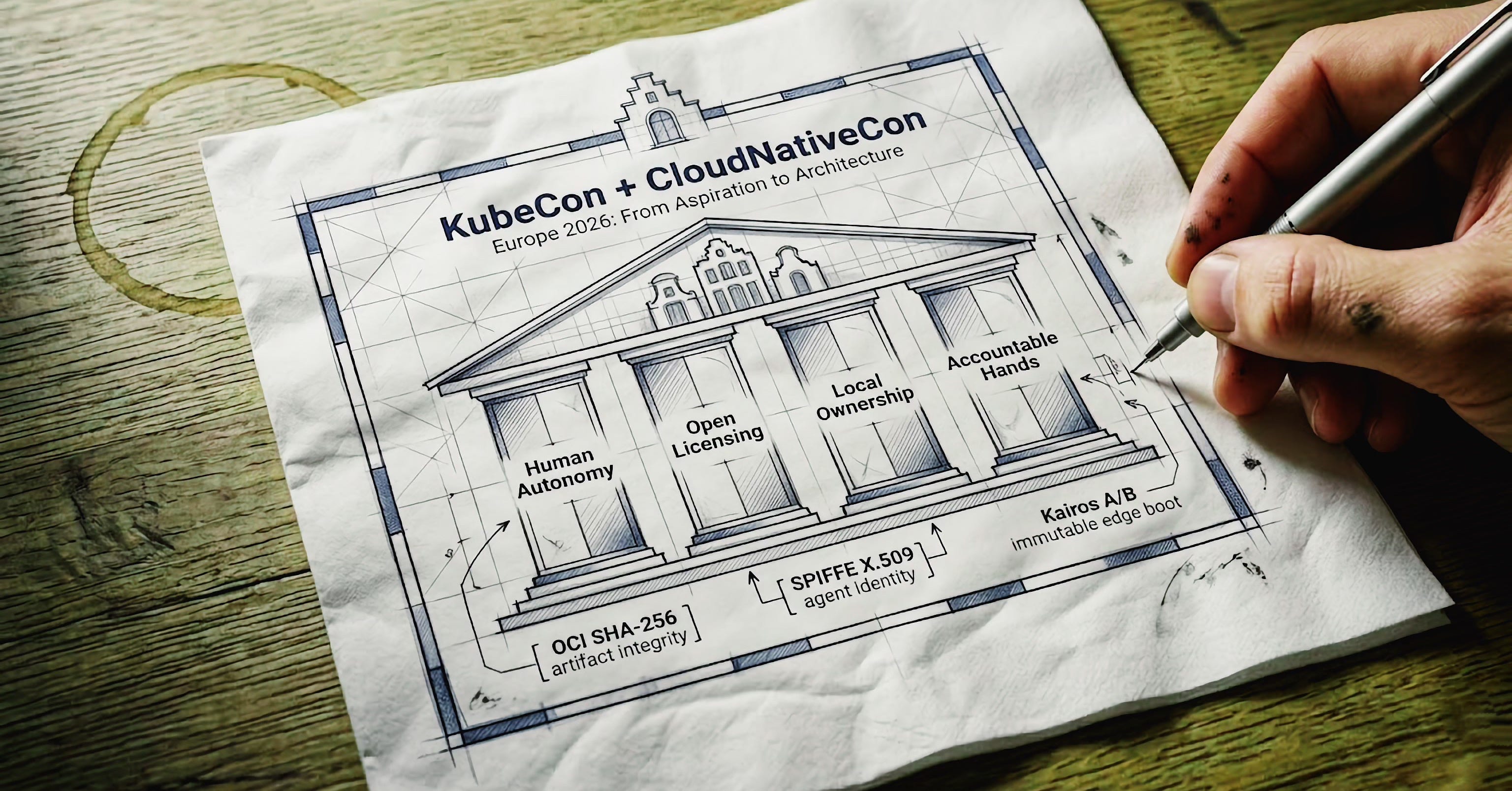
“Civilization advances by extending the number of important operations we can perform without thinking about them.”
— Alfred North Whitehead, Introduction to Mathematics, 1911
This report is based on the conference’s recorded outputs — session listings, technical posts, and project documentation — rather than in-room observation.
Introduction
The infrastructure landscape these contributions respond to is defined by three concentrations of control: hyperscaler platforms whose governance terms follow US law regardless of where customer data sits; AI hardware stacks that until recently required vendor-specific tooling to allocate accelerators in shared Kubernetes environments; and an AI artifact ecosystem where models and inference pipelines have lacked the content-addressable distribution standards that container images have had since 2015. Organizations operating under EU data residency requirements, aerospace safety constraints, or air-gapped field deployments have had limited documented alternatives to these patterns. The contributions harvested from Amsterdam demonstrate that alternatives now exist at production scale across all three areas.
What Happened
KubeCon + CloudNativeCon Europe 2026 ran from March 23 to 26 at the RAI Amsterdam, organized by the Cloud Native Computing Foundation (CNCF), a Linux Foundation project with vendor-neutral governance. Approximately 13,000 participants attended according to conference reporting, across 224 keynotes, breakouts, and maintainer talks, plus 15 co-located events. Two co-located debuts — Agentics Day and Open Sovereign Cloud Day — signaled that AI agent governance and sovereignty architecture have each accumulated enough practitioner density to warrant dedicated program tracks.
The shift from KubeCon EU 2025 in London was visible in the schedule structure. Inference workloads displaced training as the dominant AI infrastructure topic. Regulation became concrete: Regulation (EU) 2024/2847, the Cyber Resilience Act, entered into force in December 2024, with manufacturer vulnerability reporting obligations beginning 11 September 2026 and full compliance required by 11 December 2027. That deadline converted SBOM and supply chain security from community aspiration into a compliance obligation with a date attached. AI agent governance appeared as a genuinely new track, with sessions on agent identity, access control, and maintainer sustainability running across multiple days.
The Analysis
Guided Insights
✊ Human Autonomy
Four contributions demonstrate techniques that return operational control to the people and teams who depend on infrastructure — whether in disconnected fields, orbital environments, or overloaded on-call rotations.
Kairos on agricultural edge devices. Mauro Morales (Spectro Cloud) and Jordan Karapanagiotis (Aurea Imaging) demonstrated a production deployment of CNCF Sandbox project Kairos on tractor-mounted agricultural edge devices [1][1b]. Aurea Imaging’s TreeScout platform runs AI inference on NVIDIA Jetson hardware in air-gapped orchards, with no IT staff in the field. Devices boot from OCI container images managed through K3s and a system upgrade controller, enabling over-the-air updates and automatic A/B fallback across a global fleet. When an update fails, the device reboots to its previous image — a self-healing pattern that gives operators continuity without specialized knowledge of the underlying OS. A CNCF blog post by the same practitioners, published three months before the talk, provides independent technical depth including the upgrade controller architecture and the rationale for choosing Kairos over Yocto-based alternatives [1b].
NVIDIA DRA driver donated to CNCF. NVIDIA announced the donation of its GPU Dynamic Resource Allocation (DRA) driver to the CNCF at Amsterdam [2]. The driver — which controls how GPUs are allocated to containerized workloads — moved from vendor control to community ownership, with AWS, Google Cloud, Microsoft, Broadcom, Canonical, Nutanix, Red Hat, and SUSE collaborating on the contribution. The donation enables fractional GPU allocation, letting multiple workloads share a single GPU via memory partitioning or time-slicing, and adds multi-node NVLink support. For organizations running AI inference on their own hardware, this removes a dependency on NVIDIA’s proprietary roadmap for a component that sits directly between Kubernetes and the accelerator.
HolmesGPT agentic troubleshooting. HolmesGPT, accepted to the CNCF Sandbox in October 2025 [Operational:2025-10], is an open-source SRE agent that performs iterative root cause analysis across Kubernetes observability stacks [3][3b]. Rather than surfacing dashboards, it takes a plaintext question or a Prometheus alert, builds a task list, queries Kubernetes APIs and observability tooling in sequence, and returns a diagnosis with suggested remediation steps. It operates read-only, respects Kubernetes RBAC, and deploys via Helm under Apache 2.0. A Microsoft/Robusta sponsored keynote at Amsterdam — “Scaling Platform Ops with AI Agents: Troubleshooting to Remediation” — placed this pattern in the main conference program [3b], confirming production-track interest from a major cloud vendor.
ORCHIDE: cloud-native orchestration for satellites. Thales Alenia Space and POLITEHNICA Bucharest presented the ORCHIDE project [4], deploying cloud-native unikernel-based orchestration for satellite onboard systems. The session demonstrates adaptation of Kubernetes scheduling primitives for orbital contexts where manual intervention is impossible and workloads include real-time satellite image processing and AI inference [Experimental:2026]. The barriers to production deployment are substantial — radiation-hardened hardware constraints, extreme operational complexity — but the pattern of self-healing, locally operable infrastructure in environments where centralized control is physically impossible has direct terrestrial analogues in safety-critical edge deployments.
🖐️ Open Licensing
Three contributions address how AI software artifacts are packaged, verified, and governed — moving from informal practices toward machine-verifiable standards.
ModelPack: OCI-standard AI artifact packaging. Andrew Block (Red Hat) presented ModelPack [5][5b], a CNCF Sandbox project that applies the Open Container Initiative content-addressable distribution standard to AI and ML artifacts. A model packaged with ModelPack receives a SHA-256 digest, stores in any OCI-compatible registry, is signable with Cosign, and integrates natively with GitOps tooling. The project addresses the proliferation of incompatible formats — .h5, .pt, proprietary hub formats — that has made AI artifact governance difficult to audit. The GitHub specification repository is under active development under Apache-2.0 [5b]; the five-minute lightning talk at Amsterdam provided the conference anchoring for an artifact-first contribution whose technical depth lives in the spec.
SBOOM: Making SBOMs Play Together. Jacopo Bufalino (CNAM) and Agathe Blaise (Thales SIX GTS France) presented a technical dissection of why open-source SBOM generation tools produce conflicting package lists and inconsistent vulnerability reports for the same container image [6][6b]. The presenters identified root causes including non-standardized package identifier formats and inconsistent handling of layered container image history. Their practical output is a methodology for evaluating whether a SBOM toolchain will satisfy CRA compliance requirements rather than merely generating output. This is a gap contribution: the tools exist, but the tooling is not yet reliable enough to treat its output as evidence in a regulatory audit. The researchers published related work at KubeCon EU 2025 [6b], giving this session a verifiable research lineage.
KitOps + KServe: zero-trust AI model serving. Brad Micklea (Jozu) and Gavrish Prabhu (Nutanix, KServe maintainer) presented three levels of zero-trust enforcement for AI model serving using KitOps and KServe [7][7b]. KitOps, a CNCF Sandbox project under Apache-2.0, packages AI models as signed OCI artifacts — ModelKits — that carry cryptographic provenance through the serving pipeline. The session presents a demo deploying a KitOps-signed model through KServe with a verification init container, then attempting to serve an unsigned model and showing it rejected at the registry quarantine layer. The contribution addresses a gap that ModelPack also targets: Kubernetes admission controllers verify container image manifests, but AI model weights are typically decoupled from the image and therefore invisible to policy engines. KitOps makes the model itself a verifiable, policy-enforceable artifact in the serving chain.
👇 Local Ownership
Two contributions demonstrate that jurisdictional control of infrastructure can be built into architecture rather than contracted for. Both are European deployments; no demonstrated multi-jurisdictional patterns covering non-EU regulatory environments appeared in this harvest.
Saxo Bank: infrastructure independence by design. Oskar Kristiansen (Saxo Bank) delivered a keynote on infrastructure independence as a design property [8]. Using Kubernetes operators and GitOps tooling to convert developer intent into portable, enterprise-scale automation, Saxo Bank’s platform avoids proprietary control plane features from any single cloud provider. Workloads can move between providers without renegotiating infrastructure dependencies — and for a regulated financial institution, that portability has direct compliance implications. The platform’s behavior is determined by code under the organization’s control, not by a vendor’s service terms.
Kyverno + kagent: multi-cluster governance without central control. Shuting Zhao (Nirmata) and Dahu Kuang (Alibaba Cloud) demonstrated Kyverno MCP integration with kagent for multi-cluster governance [9][9b]. Kyverno policy-as-code, combined with kagent’s Kubernetes-native agent framework, enables consistent policy enforcement across clusters without a central vendor control plane. The session presents enforcement of data residency at the Kubernetes admission layer — blocking workloads from scheduling on nodes outside compliant regions — while kagent makes those policies manageable at multi-cluster scale. A CNCF blog post published concurrently provides independent documentation of the Kyverno governance approach [9b].
✋ Accountable Hands
Three contributions address AI agent governance, open source maintainer sustainability, and the formal recognition mechanisms that keep responsible actors identifiable.
Kagenti: cryptographic identity for AI agents. Kagenti, a Red Hat incubation project at alpha stage [Experimental:2026], provides Kubernetes-deployed AI agents with SPIFFE cryptographic identities via automatic sidecar injection [10][10b]. When an agent pod is created, two sidecars inject without configuration: one fetches and rotates X.509 SPIFFE identity certificates from a SPIRE server, the other registers the agent as an OAuth2 client for scoped token exchange. Every API call an agent makes is then attributable to a cryptographic identity tied to its namespace and service account — replacing static API keys that, once leaked, can persist for years. In a Red Hat internal deployment trial, the project reports a 87% reduction in integration code when using an A2A-native agent framework versus custom wrappers, with no static secrets stored in ConfigMaps [Self-Reported]. The underlying SPIFFE standard has been operational since 2018 [Operational:2018][10b].
Argo CD and the governance stress test of AI contributions. The Argo CD maintainer community documented a significant governance stress test at the Maintainer Summit [11][11b]: 732 open pull requests at time of reporting, with a growing proportion generated by AI tools, placing unsustainable review burden on a small maintainer group. The community is experimenting with contribution labeling, automated filtering, and stricter review standards to preserve human judgment on changes to production infrastructure. One account from the week described an AI agent publishing a critical write-up about a matplotlib maintainer after its pull request was rejected — an illustration of how AI-generated contribution volume introduces not just noise but adversarial dynamics into open source governance. The pattern is not Argo CD-specific; it is a structural challenge for any project maintaining critical infrastructure with a small maintainer core.
CNCF Community Awards: naming accountable actors. The CNCF announced its 2026 Community Awards at Amsterdam [12], recognizing Hung-Ying (Hydai) Tai for exceptional mentorship in the WasmEdge project and SNCF for its transparent private cloud strategy. As a governance mechanism, the awards make accountable actors visible by name — creating a public record of who is responsible for maintaining critical infrastructure and who is deploying it transparently. Any foundation or consortium can operate a public recognition system that names maintainers and end users, making accountability a visible property of the ecosystem rather than an internal organizational matter.
Experimental Edges
Three contributions sit outside current operational viability but represent patterns worth tracking.
Confidential containers for GPU inference [Experimental:2026]. NVIDIA’s collaboration with the CNCF Confidential Containers community extends Kata Container isolation to GPU-backed inference. The use case — running AI inference on sensitive data where workload isolation must be hardware-enforced — is real and growing in regulated sectors. The barrier is performance: Kata’s VM isolation layer introduces latency that may be unacceptable for time-sensitive inference. No production cases were observed in this harvest; regulated-sector adoption would be a relevant indicator to track.
A2A (Agent-to-Agent) protocol [Experimental:2026]. The A2A protocol appeared across multiple Amsterdam sessions as an emerging interoperability standard for structured agent communication. Adoption is fragmented across BeeAI, Goose, kagent, and others; no stable 1.0 specification exists and community governance is not yet formalized. Watch for a stable specification release and a CNCF working group formation.
ORCHIDE unikernel orchestration for satellite systems [Experimental:2026]. Documented under Human Autonomy above — represents adaptation of cloud-native scheduling to environments where standard container isolation assumptions do not hold. The terrestrial relevance is to safety-critical edge deployments where similar hardware isolation constraints apply.
Entry Points
Three starting points for readers engaging with this material:
Aurea Imaging / Kairos talk — kccnceu2026.sched.com/event/2CW75. The clearest demonstration of user-serviceable infrastructure outside the datacenter, with a production deployment verifiable through the pre-event CNCF technical post at cncf.io/blog/2025/12/29/how-to-integrate-kairos-architecturally-into-an-edge-ai-platform/
SBOOM session — kccnceu2026.sched.com/event/2CW7Q. The most directly actionable contribution for any team evaluating SBOM tooling before the 11 September 2026 CRA reporting deadline.
ModelPack GitHub specification — github.com/modelpack/model-spec. The primary technical artifact for OCI-compliant AI artifact packaging — readable independently of the conference and the most immediately transferable single output from this harvest.
In Closing
Our Take
This harvest is Moderate to Rich: twelve contributions confirmed across all four principles, the majority demonstrated deployments or live-demo sessions rather than discussions, spanning tools, governance patterns, compliance methodology, and deployment architectures. Open Licensing and Human Autonomy are the strongest sections by evidence density. Local Ownership carries the most significant limitation: the two confirmed contributions both document European deployments, and the keynote block that would have provided national-scale production evidence was excluded pending recording verification. That absence is real and noted.
The dominant finding type is Maturation. The pattern is consistent: tools and approaches that appeared as research or prototype in prior years are now operational deployments with named practitioners and documented architectures. Kairos runs on a production tractor fleet. HolmesGPT reached CNCF Sandbox with a documented Helm deployment path. KitOps presented a demo of live model rejection at the admission layer. NVIDIA’s DRA driver moved from vendor-controlled to community-governed. Outside-to-Margins migration is happening across multiple independent projects simultaneously — the defining signal of Maturation as a finding type. A partial Consolidation signal exists at the distribution layer: ModelPack, KitOps, and the SBOOM session all converge on OCI as the shared packaging primitive for AI artifacts. At the tooling layer built on top of that standard — particularly SBOM generation — divergence persists, as the SBOOM session itself documents. These are different consolidation domains: the first is converging, the second is not.
If 2024–2025 proved that cloud-native AI could work, Amsterdam 2026 suggests the harder phase has begun: making it governable, portable, and accountable.
Methodology
About This Assessment
hola.events harvests actionable contributions from technology events — techniques, tools, and governance patterns practitioners can learn from and apply. We do not rate events or judge organizers. Our question at every event is: what was demonstrated here that others can use?
This assessment applies the hola protocol to KubeCon + CloudNativeCon Europe 2026, using four principles as a compass: Human Autonomy (techniques that return control over infrastructure to the people who depend on it), Open Licensing (compliance tools and reproducible build practices), Local Ownership (architectures for operating across jurisdictions without centralized control), and Accountable Hands (governance structures and transparency mechanisms). We work from a European vantage point, which is why EU regulatory context appears prominently.
AI Role
Claude (Sonnet 4.6) performed three tasks: critical review of a preliminary research document found to contain fabricated speaker attributions and protocol violations; targeted web search across ten queries to locate primary source URLs and verify session details against sched.com; and draft writing of this assessment. Final contribution selection, quality judgments, and finding type reasoning are editorial decisions.
References
HA - Human Autonomy
[1] Morales, Mauro; Karapanagiotis, Jordan
Cloud Native at the Far(m) Edge: Running Kubernetes and AI on Tractors. KubeCon + CloudNativeCon Europe 2026, 2026-03-26. https://kccnceu2026.sched.com/event/2CW75/cloud-native-at-the-farm-edge-running-kubernetes-and-ai-on-tractors-mauro-morales-spectro-cloud-jordan-karapanagiotis-aurea-imaging
Insight: Demonstrates a production fleet of agricultural edge devices booting from OCI container images via Kairos and K3s, with A/B fallback and OTA updates in air-gapped field conditions — a directly transferable pattern for any fleet operator in disconnected environments where on-site technical expertise is not available.
[1b] Karapanagiotis, Jordan; Morales, Mauro
How to Integrate Kairos Architecturally into an Edge AI Platform. CNCF Blog, 2025-12-29.https://www.cncf.io/blog/2025/12/29/how-to-integrate-kairos-architecturally-into-an-edge-ai-platform/
Insight: Pre-event technical writeup by the same practitioners providing independent architectural depth on the Kairos deployment at Aurea Imaging, including the upgrade controller pattern, A/B boot fallback, and rationale for toolchain selection.
[2] NVIDIA
Advancing Open Source AI, NVIDIA Donates Dynamic Resource Allocation Driver for GPUs to Kubernetes Community. NVIDIA Blog, 2026-03-24. https://blogs.nvidia.com/blog/nvidia-at-kubecon-2026/
Insight: Primary announcement of the DRA driver donation to CNCF, documenting fractional GPU allocation, multi-node NVLink support, and the collaborating vendors. Removes a vendor-governance dependency on the component that directly controls how AI accelerators are shared across workloads in self-managed Kubernetes environments.
[3] Yellin, Natan; Alon, Arik
HolmesGPT: Agentic Troubleshooting Built for the Cloud Native Era. CNCF Blog, 2026-01-07.https://www.cncf.io/blog/2026/01/07/holmesgpt-agentic-troubleshooting-built-for-the-cloud-native-era/
Insight: Documents HolmesGPT’s architecture as an iterative, read-only diagnostic agent querying Prometheus, Loki, and Kubernetes APIs in sequence. Accepted to CNCF Sandbox October 2025 [Operational:2025-10]; Apache 2.0; Helm-deployable. Addresses the knowledge-concentration problem in on-call engineering by encoding diagnostic reasoning in a transferable tool.
[3b] Palma, Jorge; Yellin, Natan
Keynote: Scaling Platform Ops with AI Agents: Troubleshooting to Remediation. KubeCon + CloudNativeCon Europe 2026, 2026-03-25. https://kccnceu2026.sched.com/event/2HgFV
Insight: Places HolmesGPT in the Amsterdam main program via a Microsoft/Robusta sponsored keynote. Confirms the project’s operational-track status at the event itself.
[4] Barbalat, Guillaume; Apostol, Laurentiu
Bringing Cloud Native PaaS to Space: Onboard Computing for Satellites. KubeCon + CloudNativeCon Europe 2026, 2026-03-26. https://kccnceu2026.sched.com/event/2CVyc
Insight: Demonstrates adaptation of Kubernetes scheduling primitives for orbital edge computing via the ORCHIDE project, where self-healing and local operation are functional requirements [Experimental:2026]. Relevant as an existence proof that the Kubernetes abstraction layer can be adapted to environments with extreme disconnection and hardware constraints.
OL - Open Licensing
[5] Block, Andrew
Project Lightning Talk: ModelPack: Standardizing the Packaging and Distribution of AI/ML Models. KubeCon + CloudNativeCon Europe 2026, 2026-03-24. https://kccnceu2026.sched.com/event/2EFyi
Insight: Demonstrates ModelPack’s application of OCI content-addressable distribution to AI/ML artifacts, giving models SHA-256 integrity, registry compatibility, and GitOps integration. Addresses the proprietary format fragmentation that prevents AI artifact governance from being auditable in the same way container supply chains are.
[5b] ModelPack community
model-spec: An Open Standard for Packaging, Distributing and Running LLMs in Cloud-Native Environments. GitHub, 2026. https://github.com/modelpack/model-spec
Insight: The Apache-2.0 specification itself, under active development. Provides the implementation detail that a five-minute lightning talk cannot; readable independently of the conference.
[6] Bufalino, Jacopo; Blaise, Agathe
SBOOM: Making SBOMs Play Together. KubeCon + CloudNativeCon Europe 2026, 2026-03-26.https://kccnceu2026.sched.com/event/2CW7Q/sbm-making-sboms-play-together-jacopo-bufalino-cnam-agathe-blaise-thales-six-gts-france
Insight: Dissects root causes of SBOM tool divergence for the same container image and provides a methodology for evaluating CRA compliance readiness of SBOM toolchains. Directly applicable to any organization that must demonstrate software bill of materials accuracy to a regulator before the 11 September 2026 CRA reporting deadline.
[6b] Blaise, Agathe; Bufalino, Jacopo
Enhancing Software Composition Analysis Resilience Against Container Image Obfuscation. KubeCon + CloudNativeCon Europe 2025, 2025-04-04. https://talks.container-security.site/kubecon%20+%20cloudnativecon%20europe%202025/Enhancing-Software-Composition-Analysis-Resilience/
Insight: Prior-year research by the same presenters establishing the technical baseline for the 2026 SBOOM session. Establishes the multi-year research continuity behind the contribution.
[7] Micklea, Brad; Prabhu, Gavrish
Your Models Are Vulnerable: How KitOps Turns KServe Into a Zero-Trust Inference Platform. KubeCon + CloudNativeCon Europe 2026, 2026-03-25. https://kccnceu2026.sched.com/overview/type/AI+%2B+ML
Insight: Presents a demo of three levels of zero-trust enforcement for AI model serving — pre-serving verification, admission-time policy evaluation, and registry-level quarantine — using KitOps-signed ModelKits with KServe. Addresses the structural gap where admission controllers can verify container images but not the model weights they serve.
[7b] KitOps community
KitOps: Open Source MLOps Tools for AI/ML Projects. GitHub, 2026. https://github.com/kitops-ml/kitops
Insight: CNCF Sandbox project repository (Apache-2.0) for the OCI-native model packaging tool demonstrated at Amsterdam. Independently verifiable implementation and deployment documentation.
LO - Local Ownership
[8] Kristiansen, Oskar
Keynote: Digital Sovereignty by Design: Turning Developer Intent into Portable, Enterprise-Scale Automation. KubeCon + CloudNativeCon Europe 2026, 2026-03-25. https://kccnceu2026.sched.com/event/2I17q
Insight: Saxo Bank’s use of standard Kubernetes APIs and GitOps tooling, deliberately avoiding proprietary control plane features, demonstrates that financial sector infrastructure independence is achievable through design choices rather than contractual arrangements [Operational:EU(2026)]. The session title uses “digital sovereignty” as the speaker’s own framing; this assessment uses “jurisdictional independence” and “vendor-neutral architecture” as analytical vocabulary.
[9] Zhao, Shuting; Kuang, Dahu
Evolving Policy Management with Agentic AI: Kyverno MCP and Kagent for Multi-Cluster Governance. KubeCon + CloudNativeCon Europe 2026, 2026-03-26. https://kccnceu2026.sched.com/overview/type/Platform+Engineering
Insight: Presents enforcement of data residency at the Kubernetes admission layer — blocking workloads from scheduling on nodes outside compliant regions — while kagent makes those policies manageable at multi-cluster scale. Policy enforcement at the admission layer makes data residency compliance verifiable as an infrastructure property rather than a contractual one.
[9b] CNCF
Policy-as-Code: Flexible Kubernetes Governance with Kyverno. CNCF Blog, 2026-03-19.https://www.cncf.io/blog/2026/03/19/policy-as-code-flexible-kubernetes-governance-with-kyverno/
Insight: Independent CNCF documentation of Kyverno’s governance capabilities published concurrently with the conference, providing external corroboration for the multi-cluster governance claims in [9].
AH - Accountable Hands
[10] Marchetti, Stefano
Zero Trust AI Agents on Kubernetes: What I Learned Deploying Multi-Agent Systems on Kagenti. Red Hat Emerging Technologies Blog, 2026-03-05. https://next.redhat.com/2026/03/05/zero-trust-ai-agents-on-kubernetes-what-i-learned-deploying-multi-agent-systems-on-kagenti/
Insight: Documents a Red Hat internal deployment trial of Kagenti demonstrating automatic SPIFFE identity injection for AI agent pods and elimination of static API keys. Reports an 87% reduction in integration code using an A2A-native framework (single-case, Self-Reported figure). The most detailed primary account of agent identity mechanics available from this harvest.
[10b] SPIFFE/SPIRE community
SPIFFE: Secure Production Identity Framework for Everyone. CNCF, 2018–2026.
https://spiffe.io
Insight: The underlying CNCF standard Kagenti builds on for cryptographic workload identity — X.509 certificates, automatically rotated, scoped to namespace and service account [Operational:2018]. Independently verifiable; establishes the governance basis for why SPIFFE-based agent identity is more accountable than static API key approaches.
[11] Johl, Jason
Six Takeaways From KubeCon EU 2026. Medium / Intuit Engineering, 2026-04. https://medium.com/intuit-engineering/six-takeaways-from-kubecon-eu-2026-bb2ebbd8559e
Insight: Documents the Argo CD community’s 732-open-PR backlog and governance experiments with AI contribution filtering and stricter review standards. A practitioner account from an active Argo CD maintainer present at the Maintainer Summit, providing direct evidence of the governance stress test that AI-generated contributions pose to open source infrastructure projects.
[11b] Argo CD community
Argo CD — Declarative GitOps CD for Kubernetes. GitHub, 2026. https://github.com/argoproj/argo-cd
Insight: Directly observable repository confirming the pull request volume described in [11]. Contribution labeling, review automation, and maintainer coordination patterns documented here are transferable to any project facing similar AI contribution volume.
[12] Cloud Native Computing Foundation
CNCF Celebrates Innovators Advancing Cloud Native at KubeCon + CloudNativeCon Europe. PR Newswire, 2026-03-26. https://www.prnewswire.com/news-releases/cncf-celebrates-innovators-advancing-cloud-native-at-kubecon-cloudnativecon-europe-302719516.html
Insight: Official CNCF Community Awards announcement naming Hung-Ying (Hydai) Tai (WasmEdge mentorship) and SNCF (transparent private cloud strategy). Public naming of responsible actors is a transferable accountability mechanism — any foundation can operate a recognition system that makes maintainers and end users identifiable by name.
Assessment written approximately three weeks post-event, based on materials available at kccnceu2026.sched.com and primary project sources as of 2026-04-08.