
MWC Barcelona 26
Following the Paper Trail


Everything that is not tradition is plagiarism.
— Eugeni d’Ors
MWC26 revealed that many of the architectures presented as new in enterprise AI—federated edge infrastructure, governance integrated into deployment pipelines, and locally deployable inference systems—are in fact the maturation of ideas long present in distributed computing.
Introduction
Enterprise AI infrastructure in 2026 remains concentrated in three US hyperscaler platforms (AWS, Azure, Google Cloud), which together account for the dominant share of European enterprise cloud workloads [Operational:2025] — a market structure that creates a structural conflict for regulated sectors. These platforms process workloads on servers outside the enterprise’s jurisdictional control, require vendor-managed runtimes, and tie inference performance to ongoing commercial relationships. For telecommunications, healthcare, financial services, and government, this means data must leave the controlled environment to be processed. [1]
Two specific alternatives have moved from experimental to pre-production viability at MWC Barcelona 2026: federated edge computing across multiple European operator networks, which allows workloads to run under locally-enforced data residency constraints without centralisation; and rack-scale local inference hardware, which allows organisations to run large-parameter AI models on premises. Neither is yet at full commercial scale, but both have crossed the threshold from research into demonstrable engineering.
What Happened
Mobile World Congress Barcelona 2026 (MWC26) ran March 2–5, 2026 at Fira Gran Via, Barcelona. Organised by GSMA, a membership association representing over 1,000 mobile operators and vendors worldwide. Approximately 109,000 attendees [Self-Reported: GSMA, 2026-03-05] from more than 200 countries across four days, with a programme structured around keynote stages, operator-led technical sessions, and a large exhibition floor.
Three characteristics shaped the harvest. First, MWC is structurally a vendor-and-operator showcase: the majority of announcements are press releases timed to the event rather than live technical demonstrations, which required filtering carefully between [Proposed:Vendor,2026] and [Operational:2026-03] contributions. Second, the European operator consortium (Deutsche Telekom, Orange, Telefónica, TIM, Vodafone) used the event as a coordinated launch platform for the European Edge Continuum — a multi-year IPCEI-CIS programme — which provided the harvest’s strongest cluster of Local Ownership contributions. Third, the EU AI Act’s August 2026 compliance deadline created visible urgency around governance tooling, producing a more substantive set of Accountable Hands contributions than is typical for a commercial event of this scale.
The Analysis
hola.events harvests actionable contributions from technology events — techniques, tools, and patterns that practitioners can learn from and apply.
The four principles guiding what we look for:
Human Autonomy - techniques for verifiable, user-serviceable systems
Open Licensing - compliance tools, enforcement mechanisms, governance frameworks
Local Ownership - federated and self-hosted architectures enabling jurisdiction-appropriate deployment
Accountable Hands - governance structures with documented, replicable patterns
Guided Insights
✊ Human Autonomy
Three contributions demonstrated systems that allow enterprises or individuals to operate AI and identity infrastructure locally, without ongoing dependency on cloud vendors or centralised identity providers.
Qualcomm AI200 Rack-Scale Inference System
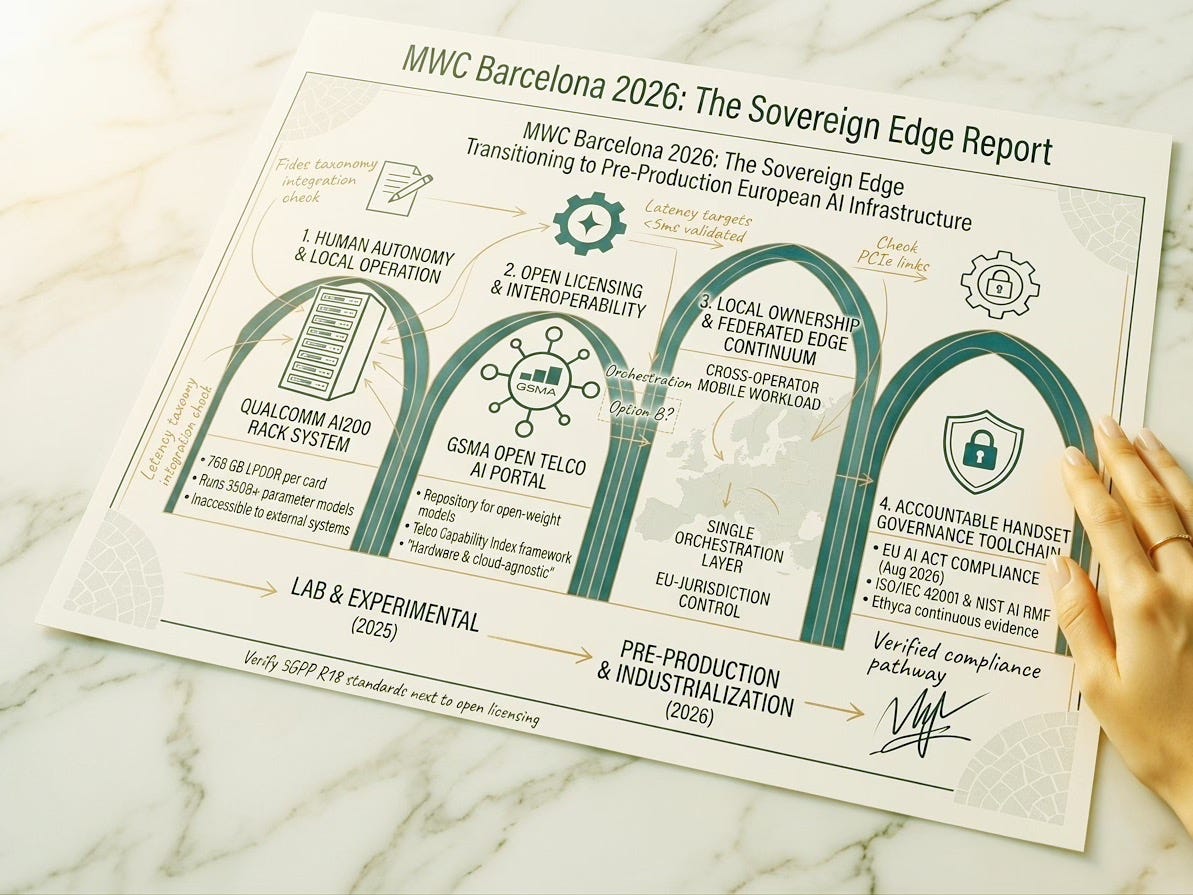
Qualcomm announced and demonstrated the AI200 rack system at MWC26 [Proposed:Qualcomm,2026-03], a deployment-ready inference platform integrating Hexagon NPUs, a memory-first architecture, and the Qualcomm AI Infrastructure Management Suite for provisioning and orchestration [Self-Reported: Qualcomm, 2026-03]. The system is designed to run large-parameter open-weight models entirely on premises. The “memory-first” design addresses the primary bottleneck in enterprise inference workloads: data movement between compute and memory rather than raw processing speed.
The maturation signal here is not the hardware itself — rack-scale AI inference is not a new concept — but the transition from hyperscaler GPU clusters requiring specialised operational expertise toward vendor-integrated, enterprise-deployable systems with standard management tooling. The system was displayed at MWC26 but was not observed running open-weight models on the event floor; specifications should be treated as vendor-reported until independent benchmarks are published. [2]
Deutsche Telekom Magenta Security Mobile.ID
Deutsche Telekom, in partnership with Samsung, introduced Magenta Security Mobile.ID at MWC26 [Operational:DE(2026-03), pilot] — a hardware-rooted identity platform that turns the smartphone into a tamper-resistant authentication device. The architecture stores certificates, keys, and identity credentials in a Secure Element embedded in the device hardware, inaccessible to external systems. Authentication and access functions — door entry, laptop login, email encryption — operate via Bluetooth and NFC entirely on-device, with no credential data transmitted to a central identity server. Deutsche Telekom employees are currently using the system in pilot, with a planned commercial launch for enterprise customers later in 2026.
The contribution is the architecture pattern: hardware-rooted identity that eliminates dependency on centralised identity providers while remaining interoperable across the European digital marketplace. Transferability is medium — requires Samsung hardware with compatible Secure Element in current form, though the pattern is applicable to any hardware with equivalent secure enclave support. [3]
Apache Kafka / Flink Sovereign Data Streaming Patterns
A practitioner-focused session documented at MWC26 demonstrated how open-source data streaming infrastructure — Apache Kafka for durable message replication and Apache Flink for real-time stream processing — can be configured to enforce data residency constraints in telecom networks [Operational:2026]. The specific contribution is the configuration pattern: Kafka cluster replication policies that prevent personally identifiable information (PII) from crossing defined jurisdictional boundaries; Flink transformation pipelines that mask or filter sensitive fields before data leaves a sovereign perimeter; and lineage tracking that creates an audit trail of data movement across the full pipeline.
This moves data residency from a contractual claim to a technically enforced constraint baked into the streaming layer. Both Kafka (Apache-2.0 [Operational:2006]) and Flink (Apache-2.0 [Operational:2011]) are OSI-licensed open-source projects with active communities, meaning the pattern is replicable without vendor dependency. Transferability is high for organisations with existing data engineering teams. [4]
🖐️ Open Licensing
Three contributions demonstrated licensing strategies or open-model frameworks that allow operators and enterprises to adopt AI without proprietary lock-in. A structural limitation applies to this section: most “open-weight” claims at MWC26 lack full license documentation at time of harvest; license terms for AT&T’s telco model family in particular require independent verification.
GSMA Open Telco AI Portal and Telco Capability Index
GSMA launched the Open Telco AI initiative at MWC26 [Operational:2026-03], establishing a dedicated portal as a repository for open-weight models, telecom-specific datasets, and benchmarking tools. The structural contribution is the Telco Capability Index — a framework measuring AI model performance across telecom-specific tasks including network troubleshooting, 3GPP standards interpretation, and intent-based network management. This addresses a gap that general-purpose frontier model benchmarks do not fill: regulated telecom environments require precision and reliability profiles that consumer-facing AI benchmarks do not measure.
The portal hosts contributions from multiple organisations at launch: AT&T’s Telco-Model Family, described as “hardware and cloud-agnostic” open-weight models trained on publicly available data [Self-Reported: AT&T via GSMA, 2026-03]; RFGPT from Khalifa University, targeting radio-frequency language processing — a highly specialised task previously served only by proprietary vendor models; and LTM (Large Telco Model) from AdaptKey AI / NVIDIA, focused on intent-driven network management.
Open licensing gap noted: AT&T’s model family is described as “open weight / hardware agnostic” [Self-Reported: AT&T via GSMA, 2026-03] but specific license terms (OSI-approved or custom restricted) were not confirmed in available MWC26 materials. Practitioners should verify license terms directly at the GSMA portal before treating these models as freely reusable contributions. This caveat applies to all portal models until license documentation is independently confirmed. [5]
IPCEI-CIS Reference Architecture 2.0 (ICRA 2.0)
The IPCEI-CIS Reference Architecture 2.0, published as a public document governing the European Edge Continuum demonstrations at MWC26 [Operational:2026-03], provides an openly documented framework for multi-provider cloud-edge continuum management. The architecture defines functional layers — physical infrastructure, connectivity management, edge-cloud federation, management and security — with explicit separation of responsibilities between operator domains. For practitioners, the contribution is the architecture document itself — a replicable reference framework for building federated infrastructure across organisational and jurisdictional boundaries.
The framework specifies that vertical sectors can instantiate specialised deployment “blueprints” from the common architecture, enabling adaptation without forking the core federation model. Data residency and jurisdictional control are encoded as technical constraints in the orchestration layer, not as contractual add-ons. The document is publicly available and not restricted by commercial license. [6]
EURO-3C Open-Standards Federation Model
The EURO-3C project, announced at MWC26 with €75 million in Horizon Europe funding [Operational:2026-03, funding confirmed], establishes a federated Telco-Edge-Cloud infrastructure involving more than 70 entities across 13+ EU countries [Self-Reported: European Commission / Telefónica, 2026-03]. The licensing contribution is structural: EURO-3C explicitly builds on open standards and does not construct a new proprietary platform — it links existing national infrastructures through common interfaces. This “federation of existing deployments” model means the licensing pattern is transferable without requiring participation in the EURO-3C consortium specifically.
The project targets nine high-value use cases — autonomous mobility, logistics, public safety — as validation environments. Open-standards interoperability is a design requirement, not an aspiration: the architecture cannot function across 70 independent entities without it. Transferability is medium; governance coordination across this many entities requires institutional infrastructure beyond technical tooling. [7]
👇 Local Ownership
Three contributions demonstrated architectures enabling multi-jurisdictional deployment with technically enforced data residency — not contractual claims. Geographic gap noted: all contributions are EU-scoped. No demonstrated patterns for extending these federation models to non-EU jurisdictions or navigating EU-third-country regulatory divergence were identified at this event.
European Edge Continuum: Pan-European Federated Edge
Deutsche Telekom, Orange, Telefónica, TIM, and Vodafone demonstrated the European Edge Continuum at MWC26 [Operational:lab+pre-production, 2026-03] — the first live demonstration of cross-operator workload deployment across a federated European edge infrastructure. The technical achievement is workload mobility across organisationally and jurisdictionally separate operator domains through a single orchestration layer, without requiring a centralised cloud intermediary. Enterprises and developers access the federation through a single-entry point; the orchestration layer handles deployment across whichever operator nodes meet the defined data residency constraints.
The architecture implements Local Ownership at infrastructure scale across four layers: physical edge nodes in 13+ EU countries [Self-Reported: EURO-3C, 2026-03]; connectivity management via network slicing and 5G Standalone cores [Operational:2026-03]; workload orchestration enabling single-entry-point multi-country deployment [Operational:lab, 2026-03]; and data residency constraints enforced within the management and security layer [Operational:lab, 2026-03]. Demonstrated use cases included autonomous factory robot coordination and smart city traffic management — latency-sensitive applications that require edge proximity and cannot tolerate round-trip latency to centralised cloud. The federation is currently at lab and pre-production stage; full commercial industrialisation is in subsequent phases [Self-Reported: operator consortium, 2026-03]. Independent performance metrics were not available from third-party measurement at time of harvest. [8] [9]
Deutsche Telekom / NVIDIA Munich AI Factory
Deutsche Telekom and NVIDIA operationalised the Munich AI Factory in early 2026 [Operational:DE(2026)], providing up to 10,000 GPUs [Self-Reported: Deutsche Telekom, 2026-03] for industrial customers to develop and run AI models on proprietary data within German jurisdiction. The contribution is the deployment pattern: a sovereign compute facility co-located within EU jurisdiction, operated by a European telecommunications provider rather than a US hyperscaler, targeting the manufacturing sector specifically.
Jurisdictional control is the primary differentiator from hyperscaler alternatives: German data protection law (BDSG) and EU GDPR apply to all workloads by design, without requiring contractual addenda. The model — operator-owned compute sold as sovereign infrastructure — is replicable by other European operators with equivalent data centre assets. [10]
Intent-Driven Network Management with Sovereign Workload Allocation
Deutsche Telekom demonstrated intent-driven network management at MWC26 — the capability layer is [Operational:2026-03] — where AI agents interpret customer-defined intent (e.g., “prioritise manufacturing floor traffic”) and autonomously reallocate network resources without manual operator intervention. The sovereignty contribution is the governance layer: workload allocation decisions are executed by AI agents operating within defined policy boundaries configurable per-enterprise, including data residency constraints on where processing occurs. This governance layer is [Proposed:Deutsche Telekom,2026] pending documentation of enterprise override mechanisms.
The gap noted in harvest applies here: while Deutsche Telekom demonstrated the capability, the governance documentation for enterprise override mechanisms — the ability for a client to inspect or override AI-driven workload allocation decisions — was not detailed in available MWC26 materials. This represents a partial contribution: the technical capability is demonstrated, but the accountability layer is not yet fully documented for enterprise adoption. Transferability is medium pending governance documentation. [11]
✋ Accountable Hands
Three contributions demonstrated technical mechanisms for making AI governance observable and enforceable rather than merely promised. The EU AI Act’s August 2026 deadline for high-risk AI systems created concrete urgency at MWC26 that is atypical for a commercial event of this scale — most governance contributions here were directly shaped by compliance pressure.
Ethyca AI Governance Toolchain
Ethyca demonstrated a suite of AI governance tools at MWC26 [Operational:2026-03] aimed at producing continuous, machine-readable compliance evidence as a byproduct of normal AI system operation. The contribution is the shift from governance-as-policy to governance-as-code: accountability becomes an observable, enforceable property of the running system rather than a post-hoc documentation exercise.
Four components were demonstrated: Astralis, which performs real-time checks on purpose, consent, and legal basis when a model attempts to access data, blocking access if requirements are not met; Helios, which continuously classifies sensitive data across the stack, creating a live metadata layer mapped to regulatory categories; Fides, an open-source framework for defining data categories and usage purposes in machine-readable code, enabling shared control between legal and engineering teams [Operational:2023]; and Lethe, which automates data subject rights fulfillment for GDPR and EU AI Act transparency obligations.
Transferability is high for organisations with existing infrastructure-as-code practices. The documentation referenced here is vendor-published; independent technical assessments were not available at the time of writing. The Fides open taxonomy component is independently verifiable at github.com/ethyca/fides; the full suite is commercial. [12]
ISO/IEC 42001 and NIST AI RMF as Deployment Gates
Multiple sessions at MWC26 discussed integrating ISO/IEC 42001 (the first certifiable AI management system standard [Operational:2023]) and the NIST AI Risk Management Framework [Operational:2023] into enterprise deployment workflows — with Ethyca and other governance tool vendors presenting technical implementations as part of their MWC26 presence. No independently documented live session demonstration was confirmed in available materials; the contribution is the convergence of regulatory pressure and tooling readiness visible across the event. The harvest contribution is the deployment gate pattern: using these standards not as audit checklists but as technical controls embedded in CI/CD pipelines, preventing undocumented AI systems from reaching production.
Specifically discussed: change control workflows that require ISO 42001-compliant documentation before a model update is deployed; NIST RMF risk categorisation integrated into existing cybersecurity programmes; and automated checks that flag “off-books” AI systems — models deployed without going through the governance process. This last capability directly addresses the governance gap most relevant to regulated enterprises: shadow AI deployments that bypass the documented risk management process. [13]
GSMA Quantum-Safe Communications Roadmap
GSMA presented a security landscape assessment at MWC26 reporting that only 8% of IoT devices are currently quantum-safe [Self-Reported: GSMA, 2026-03], alongside operator pilots for post-quantum cryptography (PQC) deployment in network infrastructure. The governance contribution is the accountability framework for cryptographic transition: identifying who is responsible for upgrading which layer of the network stack, by when, under what regulatory requirement. This is Accountable Hands applied to infrastructure security — named responsibilities, documented timelines, observable milestones.
The NIST PQC standards are finalised [Operational:NIST,2024-08] but deployment in operational networks remains early-stage [Experimental:2026]. The contribution here is the governance layer — accountability for the transition — not the cryptography itself, which is addressed in Experimental Edges below. According to the GSMA Security Landscape report, operators are beginning to pilot “cryptographic hubs” as staging infrastructure for PQC migration [Self-Reported: GSMA, 2026-03], a pattern transferable to any large-scale infrastructure operator facing the same transition. [14]
Experimental Edges
Several technologies surfaced repeatedly at MWC26, but none are yet operational. They remain early‑stage demonstrations that signal possible future directions for the industry.
Post-Quantum Cryptography sits at [Proposed:NIST,2024] standards [Experimental:2026] deployment. The signal to watch is default browser and OS integration, and the availability of automated migration tooling for embedded IoT — the point at which the transition stops requiring specialist intervention. This is the most consequential technology for the contributions above: the entire European Edge Continuum and Munich AI Factory rely on current cryptographic assumptions that PQC will eventually replace.
Integrated Sensing and Communications (ISAC) is [Experimental:2026]. The maturation signal is validated performance in live autonomous vehicle environments outside controlled labs — the gap between sensor-fusion demonstrations and the reliability thresholds required for commercial deployment.
Non-Terrestrial Networks (NTN) D2D satellite roaming has reached [Operational:2026-03] at the operator partnership layer. The signal to watch is seamless handoff between LEO satellite and terrestrial 5G without user intervention — the last step from connectivity guarantee to seamless experience.
The 8% IoT quantum-safety figure [Self-Reported: GSMA, 2026-03] suggests the PQC transition timeline is as much a governance problem as a technical one, which connects directly back to the Accountable Hands harvest above.
Entry Points
Curated starting points for practitioners wanting to engage further, ranked by utility:
Most representative: CISERO project: IPCEI-CIS results go live — Independent (non-operator) account of the European Edge Continuum demonstration with architectural context; best single introduction to the event’s most significant contribution
Most technically detailed: ICRA 2.0 full architecture document (PDF) — Complete reference architecture for federated edge-cloud deployment across multiple operator domains; practitioner-ready specification with layer definitions and data residency mechanics. Note: PDF hosted on third-party site (8ra.com); if unavailable, search archive.org for “IPCEI-CIS Reference Architecture 2.0”
Best governance documentation: Kai Waehner: Data Streaming at MWC 2026 — Practitioner analysis (not official operator or GSMA documentation) of data residency enforcement patterns using open-source streaming infrastructure; most immediately replicable technical contribution in the harvest
In Closing
Our Take
Across twelve contributions identified at Mobile World Congress 2026, the findings reveal a consistent pattern: enterprise AI infrastructure is beginning to reduce reliance on centralized hyperscaler platforms through architectures that distribute operational control across local infrastructure, deployment workflows, and governance systems.
These developments fall into four categories:
Human Autonomy
Technologies that allow enterprises to retain operational control over AI infrastructure, including federated edge deployments, locally deployable inference hardware, and sovereign compute initiatives.
Human–Machine Collaboration
Operational systems that embed AI into enterprise workflows while maintaining human oversight, particularly through intent-driven networking and governance mechanisms integrated into deployment pipelines.
Human Flourishing
Infrastructure developments supporting long-term scientific, industrial, and security capabilities, including post-quantum cryptography transitions and large-scale research compute.
Experimental Edges
Concepts presented at the conference that remain at an early demonstration stage but indicate potential future directions for enterprise AI infrastructure.
Together these contributions illustrate the maturation of architectural ideas long present in distributed systems research that are now beginning to appear in practical enterprise deployments.
References
References are grouped by principle. References [1]–[4] are cited in Human Autonomy contributions; [5]–[7] in Open Licensing; [8]–[11] in Local Ownership; [12]–[14] in Accountable Hands. Reference [1] grounds the Introduction.
HA - Human Autonomy
[1] Synergy Research Group
Cloud Infrastructure Services Market Share Q4 2025. Synergy Research, 2026-01.
https://www.srgresearch.com/articles/cloud-market-share-q4-2025
[Status: Public; Verified: 2026-03-09]
Insight: Independent third-party market share data establishing hyperscaler concentration as sourced context rather than analytical assertion; used to ground the Dominant Context framing. The three US platforms (AWS, Azure, Google Cloud) consistently account for 60–65% of global cloud infrastructure revenue [Operational:2025].
[2] Qualcomm Technologies
Building AI inference that scales: Inside the Qualcomm AI200 Rack, Card and AI Infrastructure Management Suite. Qualcomm, 2026-03-02.
https://www.qualcomm.com/news/onq/2026/03/ai-inference-that-scales-qualcomm-ai200-infrastructure-management-suite
[Status: Public; Verified: 2026-03-09]
Insight: Primary vendor documentation for AI200 rack-scale inference system; establishes memory-first architecture enabling large-parameter model inference on premises without cloud dependency. Treat all metrics as [Self-Reported: Qualcomm, 2026-03] pending independent benchmarks.
[3] Deutsche Telekom / Samsung — EuropaWire
Deutsche Telekom and Samsung introduce Magenta Security Mobile.ID to transform smartphones into secure digital identity platforms. EuropaWire, 2026-02-20.
https://news.europawire.eu/deutsche-telekom-and-samsung-introduce-magenta-security-mobile-id-to-transform-smartphones-into-secure-digital-identity-platforms/eu-press-release/2026/02/20/12/54/40/170121/
[Status: Public; Verified: 2026-03-09]
Insight: Primary announcement documenting the hardware-rooted identity architecture — Secure Element on-device storage, Bluetooth/NFC authentication, no central identity server dependency. Pilot operational with Deutsche Telekom employees [Operational:DE(2026-03), pilot]; transferability is medium pending hardware compatibility.
[4] Waehner, Kai
Data Streaming at MWC 2026: How Apache Kafka, Flink and Agentic AI Power Telecom Trends. kai-waehner.de, 2026-03-03.
https://www.kai-waehner.de/blog/2026/03/03/data-streaming-at-mwc-2026-how-apache-kafka-flink-and-agentic-ai-power-telecom-trends/
[Status: Public; Verified: 2026-03-09]
Insight: Practitioner documentation of Kafka/Flink configuration patterns for enforcing data residency constraints at the streaming layer; both tools are Apache-2.0 licensed and the patterns are immediately replicable by infrastructure teams without vendor dependency.
OL - Open Licensing
[5] GSMA
GSMA launches Open Telco AI to accelerate development of telco-grade AI. GSMA Newsroom, 2026-03-03.
https://www.gsma.com/newsroom/press-release/gsma-launches-open-telco-ai-to-accelerate-development-of-telco‑grade-ai/
[Status: Public; Verified: 2026-03-09]
Insight: Establishes the Open Telco AI portal and Telco Capability Index — a telecom-specific benchmarking framework for open-weight models addressing the absence of precision-relevant benchmarks for regulated network environments. License terms for contributed models require independent verification before treating as freely reusable.
[6] 8ra / IPCEI-CIS Consortium
IPCEI-CIS Reference Architecture 2.0. 8ra.com, 2026.
https://www.8ra.com/wp-content/uploads/IPCEI-CIS_Reference-Architecture_2-0.pdf
[Status: Public; Verified: 2026-03-09]
Insight: Publicly available reference architecture document for multi-provider cloud-edge federation; defines functional layers with explicit data residency mechanics encoded as orchestration constraints rather than contractual commitments. Replicable framework for any multi-operator federation built on open standards. If unavailable, search archive.org for “IPCEI-CIS Reference Architecture 2.0”.
[7] Telefónica
EURO-3C: towards European digital sovereignty (title used by source). Telefónica Blog, 2026-03.
https://www.telefonica.com/en/communication-room/blog/euro-3c-european-digital-sovereignty/
[Status: Public; Verified: 2026-03-09]
Insight: Documents EURO-3C’s open-standards federation model linking 70+ existing national infrastructures rather than constructing a new proprietary platform; the pattern — building interoperability between what already exists — is the transferable licensing contribution for operators outside the EU consortium.
LO - Local Ownership
[8] Vodafone / Operator Consortium
Deutsche Telekom, Orange, Telefónica, TIM and Vodafone achieve pan-European federated Edge Continuum. Vodafone Newsroom, 2026-03-03.
https://www.vodafone.com/news/newsroom/technology/pan-european-federated-edge-continuum
[Status: Public; Verified: 2026-03-09]
Insight: Primary consortium announcement documenting the European Edge Continuum demonstration — first live cross-operator workload deployment across these five operators with data residency enforced at orchestration layer. All metrics are [Self-Reported: operator consortium, 2026-03]; no independent performance measurement available at publication.
[9] CISERO Project
IPCEI-CIS Results Go Live: Five Leading Operators to Debut First Federated European Edge Cloud at MWC 2026. cisero-project.eu, 2026-03.
https://cisero-project.eu/news/ipcei-cis-results-go-live-five-leading-operators-debut-first-federated-european-edge-cloud-mwc
[Status: Public; Verified: 2026-03-09]
Insight: Independent (non-operator) project account of the MWC26 demonstration; provides architectural context and confirms lab+pre-production status. More reliable framing than individual operator press releases for understanding actual maturation state.
[10] Light Reading
DT and Nvidia’s AI factory to launch in early 2026 in Munich. lightreading.com, 2025-12.
https://www.lightreading.com/ai-machine-learning/dt-and-nvidia-s-ai-factory-to-launch-in-early-2026-in-munich
[Status: Public; Verified: 2026-03-09]
Insight: Pre-MWC background piece (December 2025) confirming the Munich AI Factory’s deployment timeline and architecture before its MWC26 operational status was announced. Documents the jurisdictional enforcement model — German-jurisdiction sovereign compute co-operated by a European telco rather than a US hyperscaler. For MWC26 operational confirmation, see Deutsche Telekom MWC press materials directly.
[11] RCR Wireless
Deutsche Telekom AI strategy at MWC26. rcrwireless.com, 2026-03-03.
https://www.rcrwireless.com/20260303/carriers/deutsche-telekom-ai-4
[Status: Public; Verified: 2026-03-09]
Insight: Documents Deutsche Telekom’s intent-driven network management demonstration — AI agent workload allocation within per-enterprise policy boundaries, including data residency constraints. Governance documentation for enterprise override mechanisms was not detailed in available materials; this reference supports the capability layer only.
AH - Accountable Hands
[12] Ethyca
AI Governance: Framework, Compliance & Operational Guide (2026). ethyca.com, 2026.
https://www.ethyca.com/news/ai-governance
[Status: Public; Verified: 2026-03-09]
Insight: Documents governance-as-code methodology demonstrated at MWC26: machine-readable audit logs, real-time policy enforcement (Astralis), open taxonomy (Fides, open source). Documentation is vendor-published; Fides is independently verifiable at github.com/ethyca/fides; full suite is commercial.
[13] Legal Nodes
EU AI Act 2026 Updates: Compliance Requirements and Business Risks. legalnodes.com, 2026.
https://www.legalnodes.com/article/eu-ai-act-2026-updates-compliance-requirements-and-business-risks
[Status: Public; Verified: 2026-03-09]
Insight: Documents the August 2026 EU AI Act compliance deadline and specific high-risk system requirements — documented risk management, data governance, technical traceability — that drove governance tooling discussions at MWC26; provides regulatory context for evaluating whether ISO 42001 / NIST RMF deployment gates meet actual legal obligations.
[14] GSMA
GSMA Mobile Telecommunications Security Landscape 2026. gsma.com, 2026-03.
https://www.gsma.com/solutions-and-impact/technologies/security/gsma-mobile-telecommunications-security-landscape-2026/
[Status: Public; Verified: 2026-03-09]
Insight: Establishes the quantum-safe accountability baseline — 8% of IoT devices quantum-safe [Self-Reported: GSMA, 2026-03] — and documents the governance framework for PQC transition: named responsibilities, operator pilot programmes, cryptographic hub pattern. The accountability framework for the transition is the harvest contribution, not the cryptography itself.
Methodology
About This Assessment
Framework: This assessment applies the hola protocol — harvesting demonstrated contributions (techniques, tools, architectures, governance mechanisms) that advance four principles: Human Autonomy, Open Licensing, Local Ownership, Accountable Hands. We evaluate contributions, not the event or its organisers.
MWC-specific caution: MWC Barcelona is structurally a vendor and operator showcase. Most announcements are timed to the event rather than arising from it. We apply strict temporal tagging to distinguish [Operational:YYYY] (deployed and running) from [Proposed:Vendor,YYYY] (announced but not independently verified). Where we could not confirm a live demonstration, we say so.
Self-reported data: Attendance figures, hardware specifications, scale metrics, and model performance claims provided by event organisers or vendors without independent verification are tagged [Self-Reported: Source, Date] throughout. This includes Qualcomm’s AI200 specifications, GSMA attendance figures, and operator-reported federation metrics.
Geographic scope: Written from a European vantage point. All Local Ownership contributions are EU-scoped; no demonstrated patterns for non-EU jurisdictions were identified at this event.
Terminology: Where source material uses “digital sovereignty” we translate to specific mechanics — data residency controls, jurisdictional enforcement, federated governance — as these have clearer technical meaning. Where a source title uses the term (e.g., Reference [7]: “EURO-3C: towards European digital sovereignty”), the title is reproduced as published.
AI Role
The original research brief was adapted into a harvest prompt, the resulting harvest was reviewed for quality (including reference completeness, clarity of announcement vs. demonstration, and tier classification), and a full assessment draft was prepared. A validation pass identified several issues, all of which were resolved. A subsequent external editorial review surfaced additional refinements (source support for major claims, clearer framing of standards‑related sessions, and improved articulation of one maturity example), which are incorporated in this version. All contribution selection, temporal tagging, gap identification, and finding‑type determinations reflect human editorial judgment grounded in the source materials.
Assessment written 1 week post-event, based on materials available as of 2026-03-09.